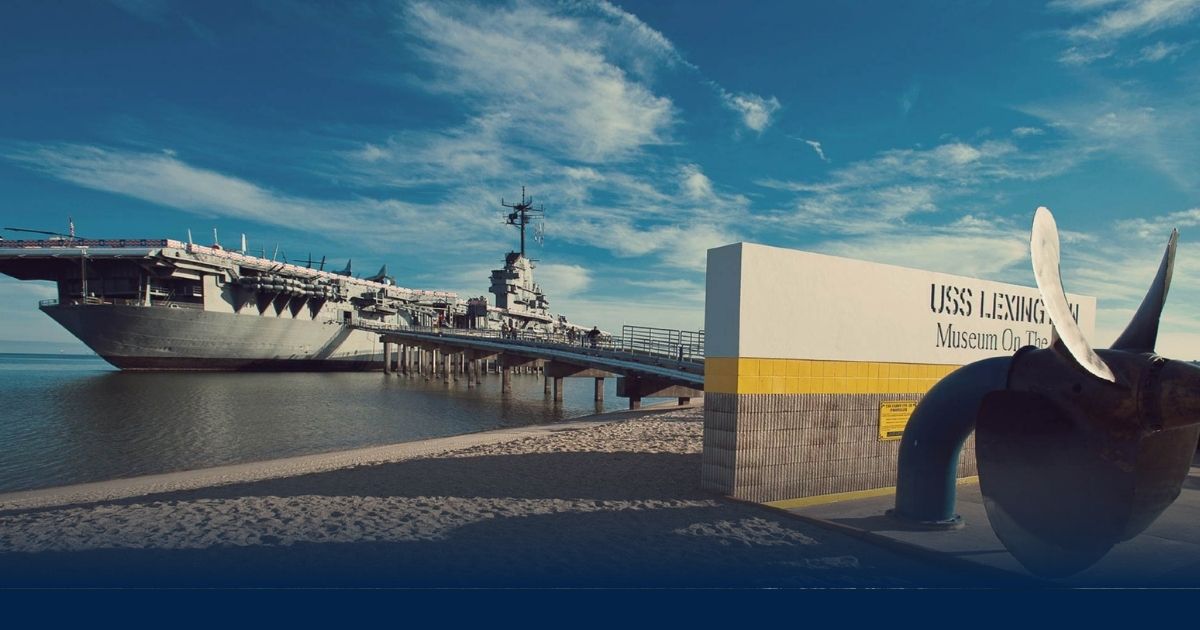
The USS Lexington Museum is one of the most enriching and memorable destinations for student groups visiting Corpus Christi. With a storied legacy shaped by its service during and after World War II, the historic USS Lexington (CV-16) offers students a powerful, firsthand look into a pivotal time in history and how aircraft carriers transformed naval warfare and reshaped the balance of power among nations.
What makes USS Lexington a great pick for student groups?
Rather than simply reading about history, students get to walk through it—climbing ladders, stepping through hatch doors, and exploring the real spaces where sailors once lived and worked. On the flight deck, they experience one of the best views of the Corpus Christi skyline while seeing historic aircraft up close, and inside the ship, immersive exhibits and the 3D MEGA Theater make them feel like part of the crew. It’s educational, interactive, and fun — a hands-on experience that truly brings history to life and stays with students long after their visit.
Can you talk a bit about specific programs/tours you have around education?
Education aboard the USS Lexington goes far beyond a traditional field trip — it’s an interactive experience designed to meet students at every grade level while keeping learning engaging and memorable. Exploring a 33,000-ton historic aircraft carrier is an adventure like no other. As students step aboard, they walk through real historic spaces such as the Ready Room, Admiral’s Quarters, engine room, and the flight and hangar decks, where they come face-to-face with historic aircraft and learn about the sailors who served and the pivotal moments of World War II, including the dramatic final days of the war in the Pacific.
The experience is enhanced by our three-story-tall 3D MEGA Theater, where Aircraft Carrier: Guardian of the Seas makes students feel like part of an active carrier crew, adding an exciting cinematic element to their visit.
For groups seeking deeper hands-on learning, our Guardians of the Seas program allows students to rotate through interactive STEM stations focused on flight, buoyancy, and WWII-era communications. Students explore the laws of motion and principles of flight, discover how a massive steel carrier stays afloat, and even practice Morse code using authentic-style equipment.
Another favorite addition is the Hunt for History scavenger hunt, which encourages students to explore the ship while uncovering key historical figures and events along the way.
Each program is designed to connect students to history through exploration, storytelling, and hands-on discovery—creating an educational experience that goes far beyond a traditional field trip and brings the legacy of USS Lexington (CV-16) to life.
Can you tell us about the overnight adventure and its highlights?
The Camp LEX Overnight Adventure program gives youth groups the rare opportunity to experience life aboard a historic aircraft carrier after hours. Designed for organized nonprofit youth organizations, the program lets participants step into the role of young shipmates—eating in chow lines, sleeping in authentic Navy racks, and learning the basics of shipboard life while exploring the legendary “Blue Ghost.”
The stay includes a showing of Aircraft Carrier: Guardian of the Seas in the 3D MEGA Theater, a patriotic flag ceremony, an evening self-guided tour of the aircraft carrier, and engaging stories that connect participants to the ship’s rich history and mystery. Dinner on arrival day and breakfast the next morning are included.
Reveille the next morning signals the start of a new day as participants pack up their gear, help return the berthing compartments to “ship shape,” and are officially mustered out with stories to share from their time aboard. Each participant also receives a special Camp LEX patch—available only to those who complete the program.
Camp LEX is open to organized nonprofit youth groups such as schools, churches, YMCA/YWCA, BSA, GSA, and similar organizations. The program is $85 per person, per night, and overnight guests also receive a $10 per person discount on the Lockdown on the LEX Escape Rooms during their stay.

What are some unique experiences at the Lexington?
One of the newest highlights aboard the USS Lexington Museum for student groups is the Women of the Navy exhibit—an immersive space that brings history to life through interactive storytelling. Students move through hands-on displays featuring holographic scenes, talking picture frames, and motion-activated experiences that share real stories of women who served. Touch-screen timelines, digital learning stations, and a virtual changing room invite students to explore Navy history in an engaging way while helping them see themselves reflected in the legacy of service. Designed to spark curiosity and confidence, the exhibit encourages students to connect with history while inspiring the next generation of leaders.
Another unique experience that sets the USS Lexington Museum apart is the Lockdown on the LEX Escape Rooms, where students can work together to solve puzzles and complete mission-style challenges inspired by real naval themes. These interactive adventures promote teamwork, problem-solving, and critical thinking in a fun, high-energy environment, making them a popular add-on for groups looking to blend history with hands-on engagement during their visit.
How do you work with Director’s Choice/student groups to make the planning process smooth and manageable?
Clear communication is at the heart of every successful visit to the USS Lexington Museum. From the early planning stages through the day of arrival, our team works closely with each group to keep the process organized, flexible, and stress-free. Prior to their visit, group leaders receive behavioral guidelines to review with students, helping set clear expectations for conduct while exploring the ship. To support supervision and safety, we recommend a 1:10 chaperone-to-student ratio, and admission is provided at no cost to help groups meet the required minimum number of chaperones.
Groups also benefit from easy bus drop-off access and convenient parking, making arrival and departure simple for both drivers and group leaders. When groups arrive, a USS Lexington Museum representative welcomes them aboard, reviews safety procedures, and helps prepare everyone for a successful visit. Theater seating is reserved in advance based on each group’s schedule to keep visits running smoothly, and if lunch arrangements are needed, our onboard caterer works directly with groups to coordinate meal options. Through open communication and strong planning, we work to make each visit easy to manage so groups can focus on enjoying their time aboard.
Anything else you’d like to let student groups know?
We invite students of all ages to step aboard the USS Lexington Museum and experience history in a way that goes far beyond the classroom. Here, learning comes to life as visitors walk the same passageways once traveled by young sailors and stand on the flight deck where teamwork, courage, and innovation shaped history. These moments remind us that history isn’t just something we read about — it’s something we can see, feel, and experience together.
With opportunities to explore history, science, geography, and real-world problem solving, the USS Lexington Museum offers something for every student. Our goal is to spark curiosity, encourage discovery, and create an environment where young people can imagine new possibilities for themselves. As a community, we are proud to provide a place where students can explore, learn, and begin to see their own potential as the leaders of tomorrow.
Photos courtesy of USS Lexington Museum.